William FORREST was born in the 1770s near Blackburn.
Serjeant William FORREST
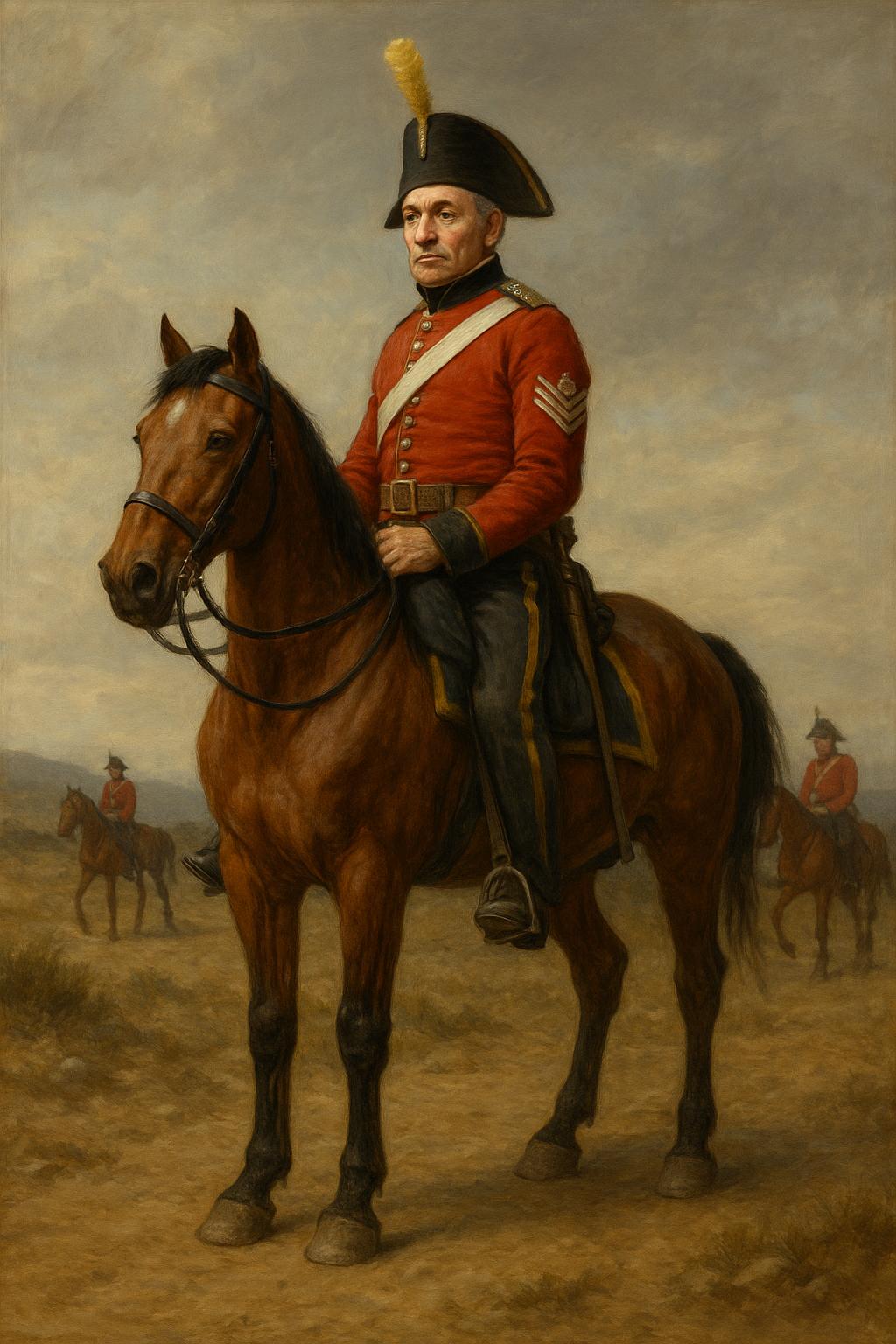
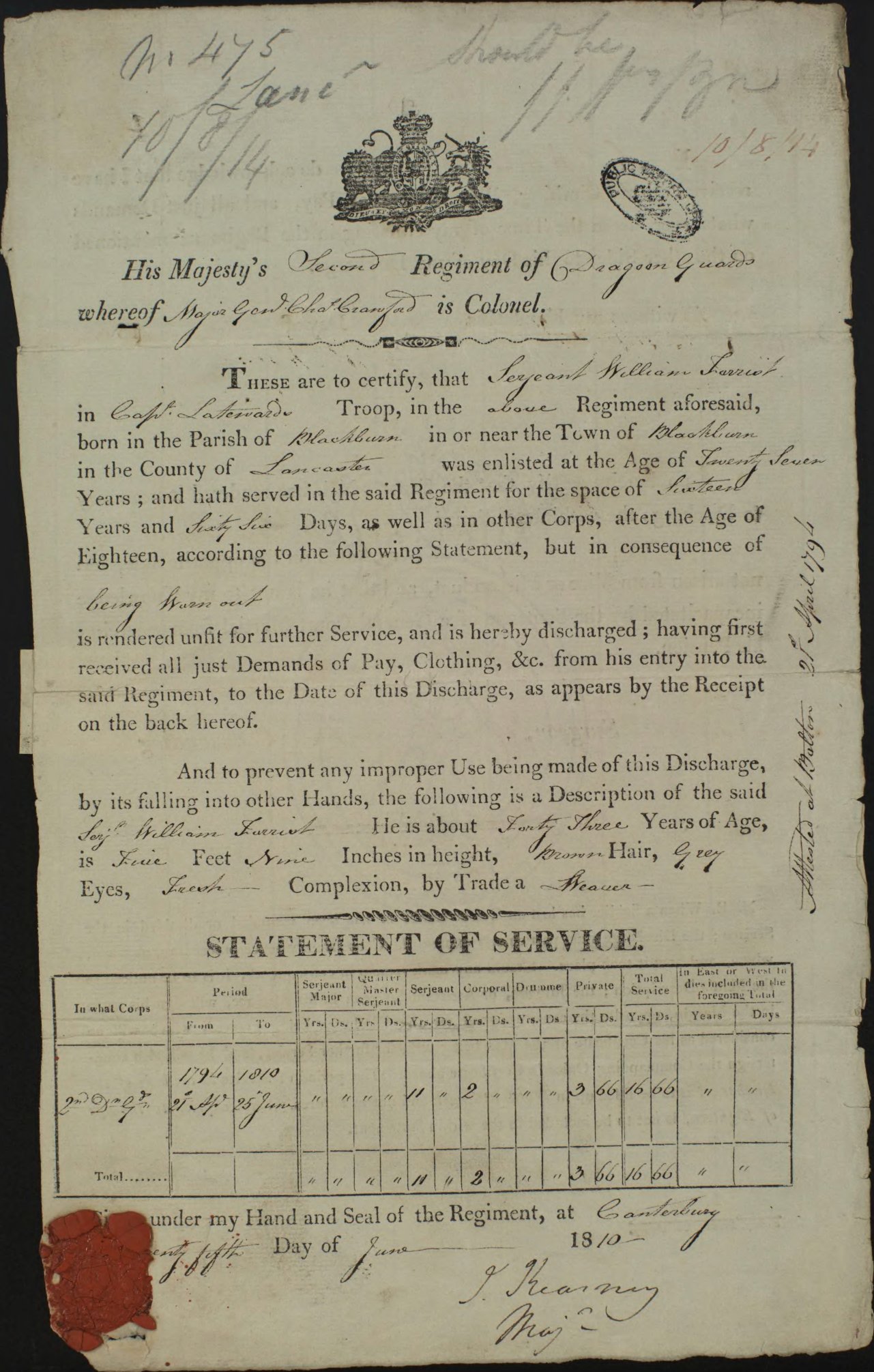
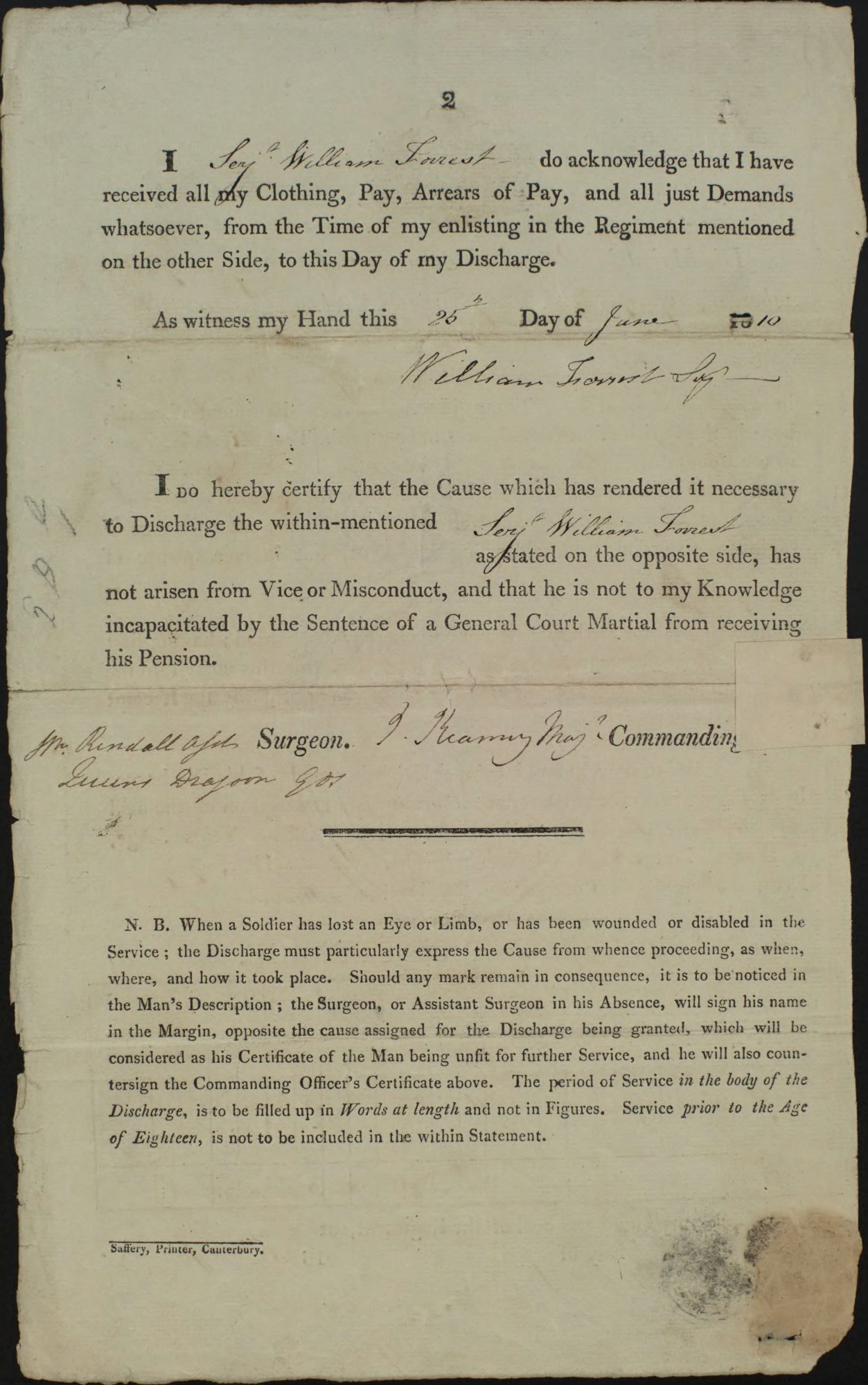
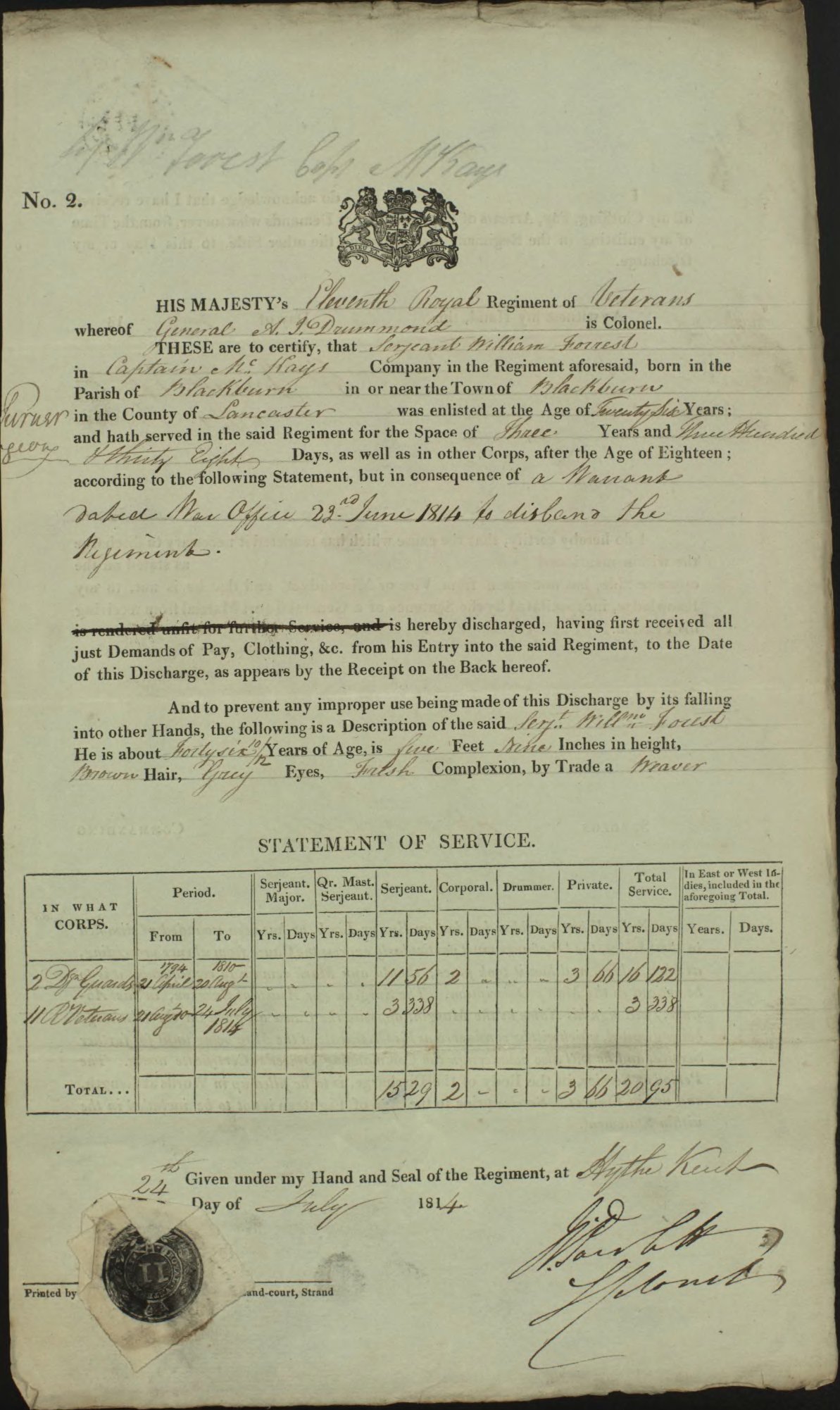
Serjeant William FORREST served with the 2nd Dragoon Guards (a cavalry regiment called "the Queen's Bays" after their bay horses). Serjeant William, of Blackburn was a weaver by profession when he joined the corps on 21 April 1794. He served for 16 1/2 years before being transferred to the Regiment of Veterans for another 4 years to 24 Jul 1814 when it was disbanded1.
The Bays were in the Low Countries and northern France during the first two years of the French Revolutionary War, between May 1793 and March 1795. After initial success they were later forced to retreat to Germany where they suffered from sickness and starvation which killed many men and horses. Serjeant William, who was enlisted in the Bays on 21 April 1794, would not have been involved, but was possibly transferred to the regiment to make up for losses in the field.
It's not clear where the Bays where posted for the next 15 years, but Serjeant William spent 3 years as a Private, 2 years as a Corporal and 11 years a Serjeant.
The Bays next known posting was not until 1809, when they were sent on the disastrous campaign to Walcheren, with the aim of destroying the French-held port of Antwerp. The Bays embarked in Ramsgate in July 1809 as part of a force of 40,000 men. The poor sanitary conditions, malaria and "Walcheren fever" killed ten percent of the force and weakened the survivors. They were back in Ramsgate by 6 Sep 1809.
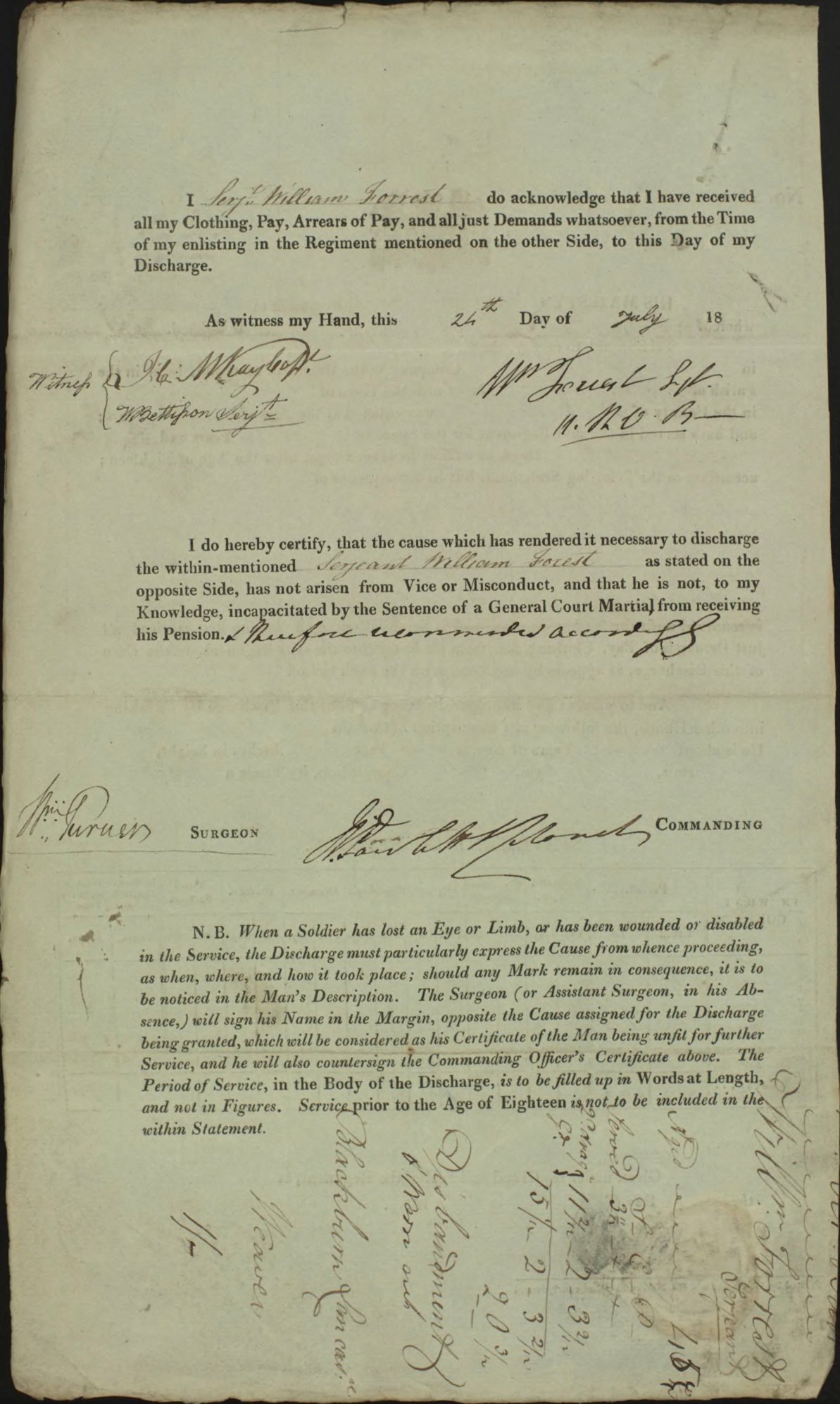
Serjeant William was transferred to the Regiment of Veterans the following year, due to him "being worn out". It's possible that this was age related, but he may have been suffering from the lingering effects of the "Walcheren Fever". As a Serjeant, William would have been able to read and write, and he signed his name fluently on both of his discharge papers.
At his final discharge from the Veterans on 24 Jul 1814, Serjeant William FORREST was 46 years 10 months old, indicating his birth date as Sep 1767. He was described as being 5' 9" tall, brown hair, grey eyes and fresh complexion.
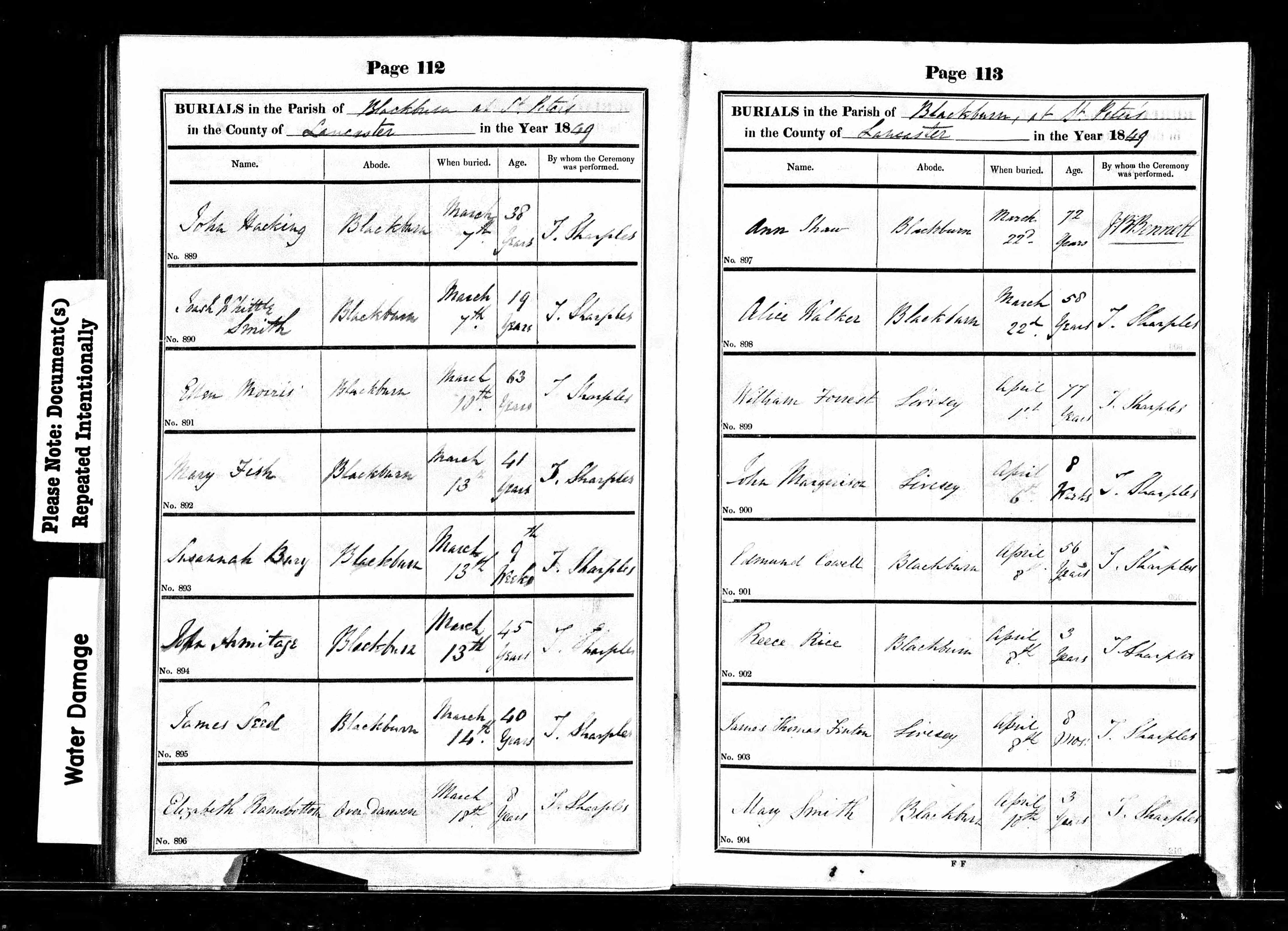
A William FORREST, Chelsea Hospital pensioner, died on 30 Mar 1849, aged 76 and 11 months, in the Livesey area of SW Blackburn2. It is less than 3 miles from Wagtail, Duke's Brow. The death was reported by Thomas FORREST of Livesey, who was likely a son who had been caring for Serjeant William. The age on the death certificate suggests a birth in April 1772.
he 1841 Wagtail family4
In 1841 a family of four FORRESTs were living at Wagtail, Duke's Brow, all working as cotton weavers, including: William FORREST, 65-69, James FORREST, 35-39, Ann, 15, and James, 9. Neither this 'Wagtail William" nor the older James are good fits for being the children's father(s); no record of a James baptizing a James or an Ann has been found.
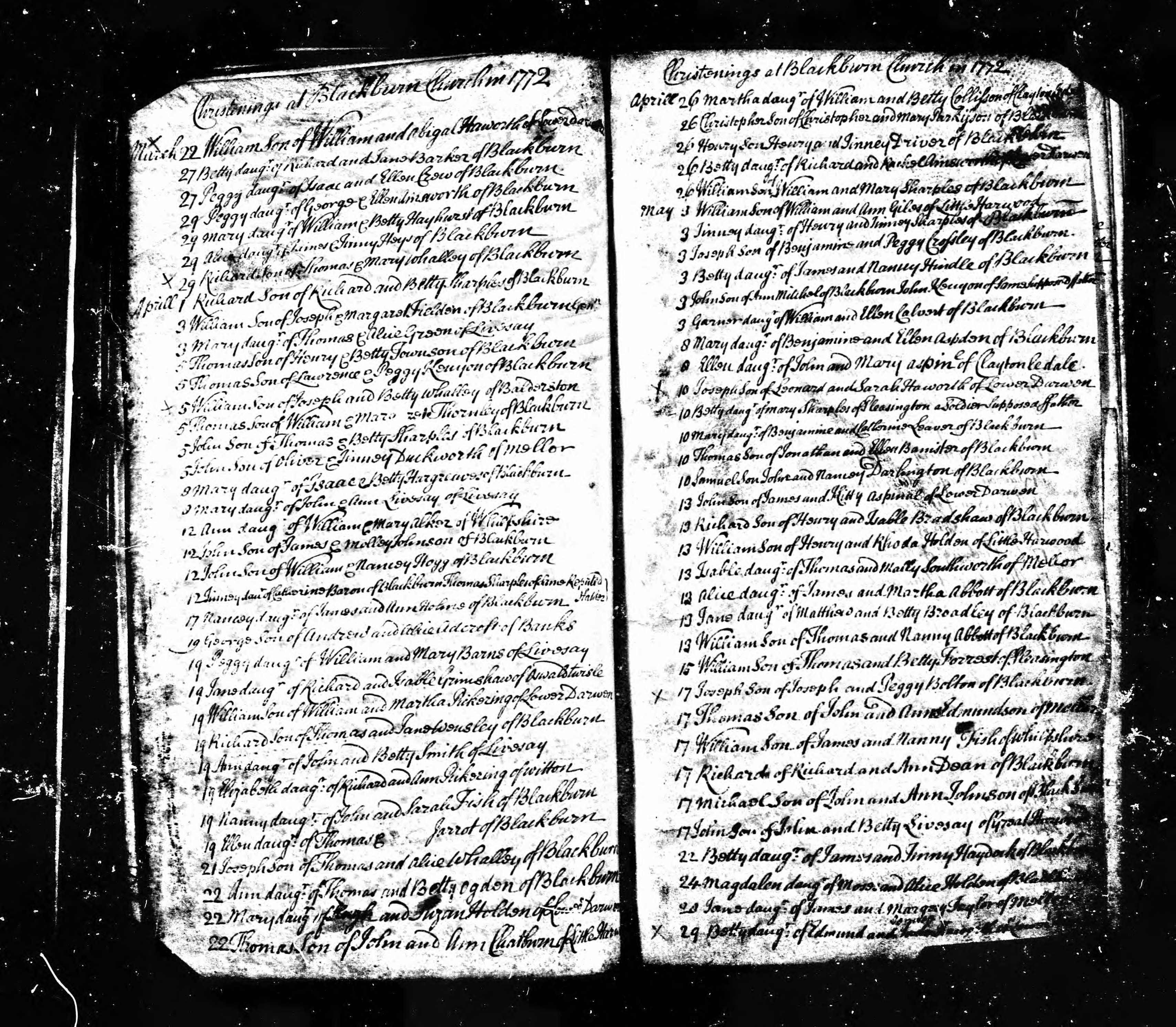
Ann and James are, however, good matches for being the children of William FORREST, specifically the daughter of William and Mary UNKNOWN and the son of William and Nancy ELLISON. Indeed, there are no other census records for either Ann or James of the right age in/around Blackburn. The only Ann baptized in/around Blackburn of the right age, is that of William and Mary UNKNOWN as per
As Wagtail William was living in 1841, but not found in 1851, then his death would have been registered between 1841 and 1851. The only matching death record is for a William FORREST, an 'out pensioner of the Chelsea Hospital' who died of old age in Livesey, Blackburn on 13 Mar 1849, aged 76 & 11 months (born c. April 1772)3. It is believed to be the death registration of Sergeant William FORREST of the 2nd Dragoon Guards.
RESEARCH NOTEBOOK: Miscellaneous Facts, Leads & Theories Concerning William Forrest and Family
1. Brick-making references & occupational context
1.1 Confirmed occupational fact
- 1854: On James Forrest’s marriage certificate, his father William is described as a brick maker .
1.2 Contextual factors
- 1851 repeal of brick tax triggered a brick-making boom.
- William may have entered brick-making late , around 1851–54.
- Most working people in Blackburn in early 19th century were cotton weavers , not brick makers.
- Brick-making was often temporary, itinerant , and tied to construction sites.
1.3 Local sites
- Brick kilns at Brandy House Brow near Grimshaw Park existed by 1886 , probably built in the 1860s–70s .
- Mid-century brick-making was likely temporary field kilns , so employment could be anywhere.
1.4 Individuals named William Forrest linked to brickmaking (excluding best-fit William)
- Sandbach, Cheshire (1834)
- >William (bricklayer) & Elizabeth baptise James (b.1834). Also baptised Jane (1831).
- >Eliminated: Wrong birthplace for James; family structure incompatible.
- Bloxwich, Walsall (1841)
- >William Forrest, 40, brick maker, with wife Maria and many Staffordshire children.
- >Maria is a widow by 1851.
- >Eliminated: Wrong status in 1854 (dead), wrong children, wrong region.
- Astbury / Congleton (1841)
- >William Forrest, journeyman bricklayer, with Mary and several children including a James (7).
- >Their James was baptised in Sandbach; later appears in Congleton.
- >Eliminated: Wrong birthplace for James.
- Liverpool (1851)
- >William Forresh/Forrest, 39, unmarried, brick maker, from Winsford, living in labourers’ lodgings.
- >Not eliminated but uncertain. Age misaligned by ~10 years.
- Flagger/slater William Forrest (married 1819 to Elizabeth Bolton)
- >Proven not correct line.
2. William’s marriages: eliminations & possibilities
2.1 Marriage candidates for “first wife” before 1832
(Only those that could be William’s first marriage are listed. Many can be eliminated.)
Discarded marriages
- Margaret Barnes (1813) — Husband was a weaver/gamekeeper/drawer-in. Children known.
- Jennet Howarth (1818) — No baptisms; a Jennet Forrest (b.1789) appears alone in 1841.
- Ellen Clayton (1818) — Children Jenny (1819) and Ann (1820) but no link to later Ann/Ellen; multiple possible deaths 1821; wrong fits.
- Ann Ingham (1819) — Husband was a joiner.
- Elizabeth Bolton (1819) — Husband was the flagger/slater line.
- Mary Edmundson (1823) — Fits Lower Darwen family; entirely separate.
- Hannah Pemberton (1824) — Husband was manufacturer; wealthy line.
- Mary Sharples (1825) — No children afterwards; some possible burials but pattern weak.
- Ann Heaton (1828) — Husband was a baker.
- Isabella Myerscough (1829) — They are in Preston 1851; husband a labourer in malt kiln; wrong children.
- Mary Walmsley (1832) — Husband was a blacksmith.
- Jane Longworth (1832) — Not relevant.
Viable first-wife candidates * Mary (surname unknown)
- >Ellen baptised 1821, Samlesbury
- >Ann baptised 1825, Balderstone
- >Mary likely buried 1826, aged 35
- >This fits birth spacing, locations, children’s names.
- Remote possibilities (less supported)
- >>Jennet Howarth (if first wife died and left no children; but insufficient evidence)
- >>Ellen Clayton (but baptisms do not match surviving children Ann/Ellen) >
Overall: >Mary UNKNOWN is the strongest.
2.2 Marriage candidates for “second wife”
- Nancy Ellison , married 1832, is strongest candidate:
- >Born Mellor 1803.
- >Died Mellor 23 July 1838 in childbirth.
- >Her presence in Mellor fits James’ birthplace.
- >The marriage date fits James’ birth window (c.1833).
- >Naming patterns in James’ children support this.
3. Evidence concerning William’s children
3.1 Children attributed to William
- Ellen (baptised 1821, Samlesbury)
- Ann (baptised 1825, Balderstone)
- James (born c.1833, Mellor)
3.2 1841 census placements
- Ellen , 15–19: Living in Mellor with another family, possibly linked to future lodgings for James in 1851.
- Ann , 15: Living at Wagtail, Duke’s Brow with extended Forrest relatives.
- James , 9: Same household as Ann.
3.3 Theoretical placements
- Children were distributed among relatives after Nancy’s death in 1838.
- The “Wagtail” household included likely:
- >>Serjeant William (b.1772), uncle
- >>James (younger brother of William)
4. The Wagtail, Duke’s Brow household (1841)
4.1 Individuals
- Serjeant William Forrest , 65–69 (b.1772), Chelsea Pensioner
- James Forrest , 35–39 (likely William’s younger brother)
- Ann , 15 (William’s daughter)
- James , 9 (William’s son)
4.2 Relationships
- If genealogical reconstruction is correct:
- >Serjeant William is William’s >uncle .
- >The younger James is William’s >brother .
- >Ann and James placed with extended family after Nancy’s death.
4.3 Additional notes
- Serjeant William died 1849 in Livesey; death reported by Thomas Forrest , possibly another brother.
- Family tree suggests large interconnected Forrest family in Mellor/Blackburn area.
5. Socioeconomic background
5.1 Decline of handloom weaving
- 1830s: severe drop in demand due to power looms.
- 1837: wages cut 25% in one year.
- 1841–42: widespread near-starvation; 7,000 people in Blackburn living on 2s 8d weekly.
- Lammack/Duke’s Brow area deeply affected.
5.2 Relevance to William
- Likely explains:
- >family instability
- >dispersal of children
- >potential descent into poverty/alcoholism
- >occupational shifts (warper → brick making)
6. Suicide case (1844) – evidence & details
6.1 Key facts
- 1841: A William Forrest, warper, 45–49 , lodging on Birley Lane (Snig Brook area).
- 21 October 1844: Body found in Blackburn reservoir.
- Age 49.
- Occupation: warper.
- Known to have declined due to drink.
- Former member of Blackburn Glee Club.
- Coroner involved; report in Westmorland Gazette (26 Oct 1844) .
- Buried 24 Oct 1844 at St John the Evangelist, Blackburn.
- 1845 Q2 GRO death registration: age 49, cause: drowning .
6.2 Fit with William of Mellor
- Age fits (b.1794–95).
- Occupation consistent with weaving background.
- Lodging location matches (Snig Brook near Birley Lane).
- Circumstances (poverty, drink, isolation) align with life events.
6.3 Alternative theory
- Family may have later minimised or misremembered his fate:
- >telling children he had “left Blackburn” and become a brick maker.
7. GRO death registrations considered (non-infant, Blackburn/Preston)
Probable match
- Q2 1845 — William Forrest, 49, Blackburn — Drowned 1844 .
Eliminated or unrelated
- Q1 1839 Blackburn — Son of Dr. William Forest; unrelated.
- Q4 1844 Blackburn — Unusable record (superseded); likely same as 1845 entry.
- Q3 1873 Blackburn , Q2 1876 Preston , Q4 1877 Preston , Q2 1883 Blackburn — Ages incompatible with William b.1794–95.
8. Additional records of interest (possible but not confirmed relatives)
8.1 James Forrest baptised by Charlotte Forrest (1835)
- Uncertain significance; mother unmarried; may be collateral line.
8.2 Eanam voter (1847)
- William Forrest of Eanam plumped for Mr Hornby (election).
- Identified as Will Forrest, flagger/slater (different man).
8.3 Edmund Edmundson
- 1841 lodger next to William Forrest household.
- Connections to Mellor, Samlesbury and Balderstone.
- Possible link to Mary Edmundson (but no confirmed marriage).
8.4 A William Forrest baptised in Balderstone 1815
- Son of Edmund Forrest and Mary.
- Could indicate extended family in same villages.
8.5 Other Forrests with criminal or unusual records
- 1837 Preston — William Forrest death sentence commuted; unrelated.
- 1842 Lancashire assizes — William (37) & companion Thomas (30) imprisoned; could be brothers but parents unknown.
- 1809 Balderstone — Peter Forrest (37) convicted of manslaughter.
- 1815 Will of a William Forrest, yeoman of Mellor.
- 1833 Quarter sessions — Thomas Forrest, reputed father of illegitimate child; sureties include a William Forrest of Preston.
8.6 Property reference (1835)
- Auction of dwellings with weaving shops in Clayton-le-Dale occupied by Henry and William Forrest — two years after James’ birth, one year before Nancy’s death. Possible link.
- Clayton-le-Dale is 2.5 miles from Mellor.
9. Outstanding Research Questions
9.1 Identity questions
- Who exactly was Mary (first wife) ? Was she:
- >Mary from Samlesbury (d.1826, aged 35)?
- >Another Mary recorded in Balderstone/Darwen?
9.2 Children’s fates
- Ellen after 1841 — no confirmed census or marriage yet.
- Ann after 1841 — similarly untraced.
9.3 William’s occupation
- Was he truly a brick maker , or was this:
- >temporary work?
- >a family euphemism?
- >a misunderstanding by his son James?
9.4 Final fate
- Did William:
- >>Die by suicide in 1844 , as the evidence strongly suggests?
- >>Leave Blackburn and work as a brick maker elsewhere? >
Even if #1 is correct, family myth #2 may have persisted.